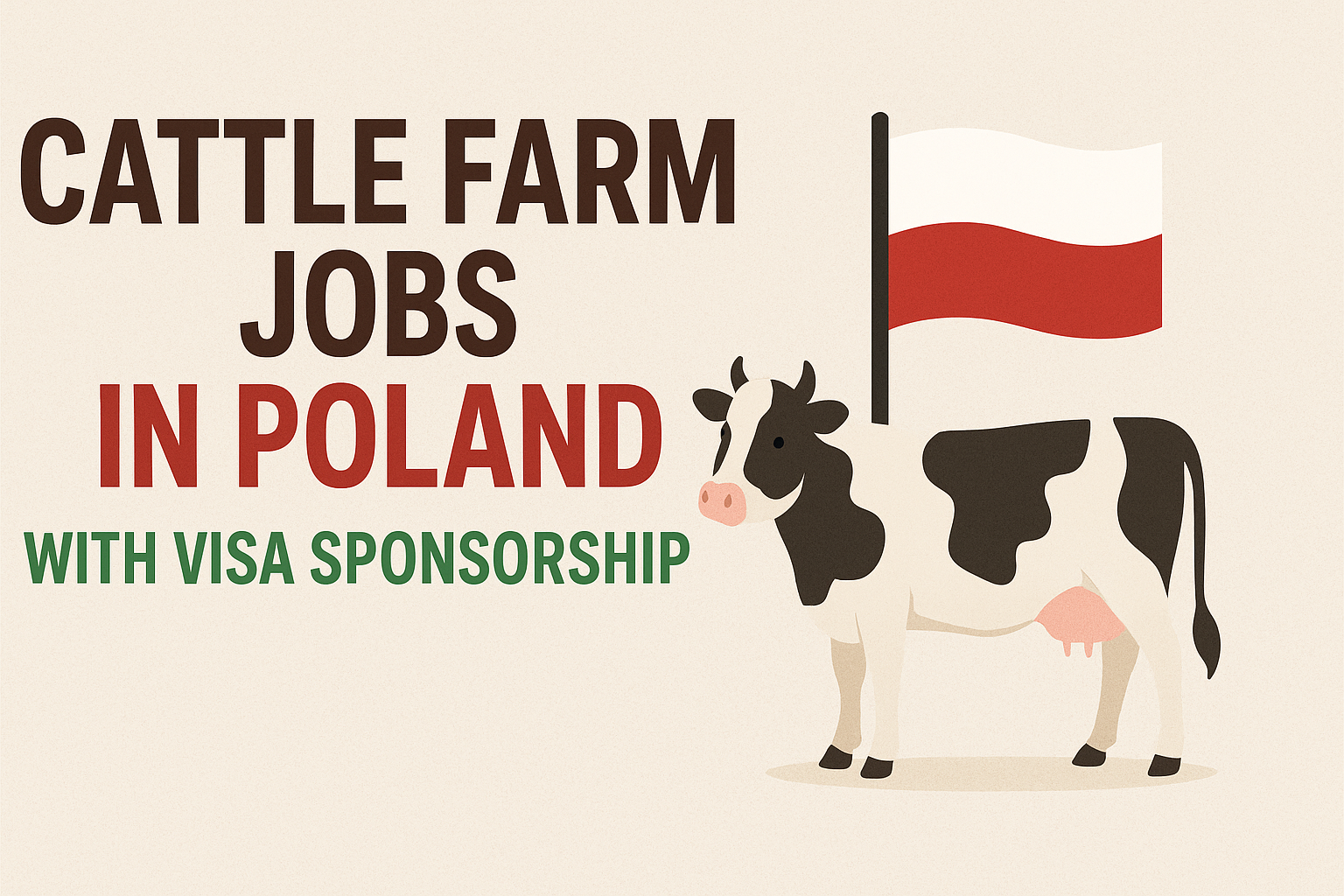
Cattle Farm Jobs in Poland with Visa Sponsorship
Cattle Farm Jobs in Poland with Visa Sponsorship Poland’s agricultural sector, particularly livestock and dairy farming, is expanding due to high demand for meat, dairy, and poultry products. This has created numerous opportunities for foreign workers in cattle farming (often encompassing dairy and beef operations) with visa sponsorship, especially for non-EU citizens. Many roles are available for 2025 and 2026, targeting entry-level to experienced workers amid labor shortages in rural areas. Employers often provide visa sponsorship through Type A work permits, along with benefits like free accommodation and meals. These jobs are suitable for those interested in animal care and outdoor work, with no prior experience required in many cases, though physical fitness is essential.
Overview of Cattle Farm Jobs in Poland with Visa Sponsorship
Employers often provide visa sponsorship through Type A work permits, along with benefits like free accommodation and meals. These jobs are suitable for those interested in animal care and outdoor work, with no prior experience required in many cases, though physical fitness is essential.
Key Job Roles Related to Cattle Farming
Cattle farm jobs typically fall under broader categories like animal farm workers or livestock farm assistants. These roles focus on dairy cattle operations, which are prominent in Poland. Common positions include:
- Animal Farm Worker: Involves daily care for livestock such as cows, including feeding, watering, cleaning enclosures, monitoring health, milking, and assisting with breeding or calving.1 Training is provided on-site.
- Livestock Farm Assistant: Focuses on feeding and caring for cattle, cleaning barns, and supporting breeding programs on cattle, pig, or poultry farms.2
- Animal Husbandry Specialist: More advanced role involving feeding, cleaning, and health management for livestock on dairy or beef farms, often requiring some experience.3
These jobs are often seasonal (peaking April–September) but can lead to long-term contracts of 1–2 years, renewable.
Requirements
To qualify for these roles with visa sponsorship:
- Age: Typically 21–50 years old.1
- Physical fitness: Ability to handle manual labor, outdoor work, and animal handling.
- Experience: Preferred but not always required; entry-level positions welcome beginners, while supervisory roles may need 2+ years in farming or veterinary work.14
- Language: Basic English or Polish; not mandatory for all roles.
- Other: Valid passport (at least 6 months validity), no criminal record, and willingness to work in rural areas.1
- For specialized roles: Relevant skills like machinery operation or animal health knowledge may be needed.3
Salary and Benefits
Salaries vary by experience, role, and region, but are competitive for entry-level foreign workers. Benefits often include visa support to attract international talent.
| Job Role | Average Monthly Salary (PLN, Gross) | Equivalent (EUR, Approx.) | Key Benefits |
|---|---|---|---|
| Animal Farm Worker | 3,200 – 4,500 | €750 – €1,000 | Visa sponsorship, free/low-cost accommodation, free meals/allowance, health insurance, paid overtime (40–48 hours/week), transportation, paid leave.1 |
| Livestock Farm Assistant | 2,500 – 4,000 | €580 – €930 | Free/subsidized housing, access to modern equipment, career advancement opportunities, potential path to permanent residency.2 |
| Animal Husbandry Specialist | 4,500 – 8,000+ | €1,050 – €1,860+ | Similar to above, plus potential for higher pay with experience; standard 40-hour workweek.3 |
Overtime is paid separately, and employers must comply with Polish labor laws for fair wages and conditions. The minimum hourly rate is around 28 PLN gross.
Locations
Cattle and livestock farms are concentrated in rural regions with strong agricultural traditions:
- Mazowieckie (near Warsaw): Poultry and dairy farms.
- Wielkopolskie (Poznań area): Cattle and pig farms.
- Podlaskie: Large-scale dairy operations.
- Lubelskie and Małopolskie (Kraków region): Mixed livestock farms.13
Visa Sponsorship Process
Visa sponsorship is common for these jobs, handled by the employer. Non-EU workers typically need:
- A job offer from a licensed Polish employer.
- Employer applies for a Type A Work Permit at the local Voivodeship Office (takes 1–2 months).
- Receive work permit approval and job invitation letter.
- Apply for a National Visa (Type D) at your local Polish Embassy, submitting documents like passport, job offer, and proof of funds.
- Attend a visa interview; approval takes 6–10 weeks total.
- Upon arrival in Poland, register for a Temporary Residence Permit if staying over a year.123
Government programs support seasonal agricultural visas. Always verify employer legitimacy to avoid scams.
- Tailor Your Application Materials: Customize your CV to emphasize any agricultural, animal care, or manual labor experience, even if entry-level. Include skills like animal handling, machinery operation, or basic veterinary knowledge. Mention your willingness for visa sponsorship explicitly in your cover letter. Keep it concise (1-2 pages) and include your passport details and availability for 2025/2026 roles. Use platforms like LinkedIn or Indeed to find templates for Polish farm job applications.
- Learn Basic Polish or English Phrases: While many employers don’t require fluency, basic knowledge of Polish (e.g., farm-related terms like “krowa” for cow or “dojenie” for milking) or English can set you apart. Free apps like Duolingo or YouTube tutorials can help. No language barrier is often noted for seasonal roles, but it aids communication during interviews.
How To Apply
Apply Now
Conclusion
Cattle farm jobs in Poland with visa sponsorship represent a promising opportunity for foreigners seeking stable, hands-on work in a growing agricultural sector. As a cornerstone of Poland’s economy, dairy and livestock farming provides entry-level roles with competitive wages (from €580-€1,860/month), comprehensive benefits like free housing and health insurance, and pathways to long-term employment or even permanent residency. With labor shortages driving employer-sponsored visas for 2025 and 2026, now is an ideal time to apply—especially for motivated individuals aged 21-50 with physical stamina. While challenges like rural isolation and weather exist, the experience builds valuable skills, cultural immersion, and financial stability. Ultimately, these positions not only address Poland’s need for workers but also offer foreigners a rewarding entry into European agriculture. If you’re prepared, this could be your gateway to a fulfilling career abroad.
FAQs on Cattle Farm Jobs in Poland with Visa Sponsorship
Here’s a table summarizing common questions based on recent guidelines and job postings. These address key concerns for non-EU applicants.
| Question | Answer |
|---|---|
| Do cattle farm jobs in Poland offer visa sponsorship? | Yes, many employers, especially in dairy and livestock sectors, provide sponsorship through Type A work permits for non-EU workers. This includes processing support for seasonal (up to 9 months) or long-term roles, with extensions possible depending on the job and employer. |
| What is the typical duration of a sponsored farm visa? | Seasonal visas last up to 9 months, ideal for peak farming periods. Long-term contracts can extend to 1-2 years or more, with options for temporary residence permits if staying over a year. |
| Is experience required for these jobs? | No, entry-level positions welcome beginners with no prior experience, though basic physical fitness is essential. Advanced roles like animal husbandry specialists may prefer 2+ years in farming. Training is often provided on-site. |
| What documents are needed for the visa application? | Key documents include a job offer letter, valid passport, work permit approval from the employer, medical exam results, proof of no criminal record, and evidence of sufficient funds. The employer handles much of the permit paperwork. |
| Are there language requirements? | Basic English or Polish is helpful but not always mandatory, especially for manual labor roles. Safety instructions may require some proficiency, but many farms use multilingual supervisors. |
| What benefits come with these jobs? | Common perks include visa sponsorship, free or low-cost accommodation, meals or allowances, health insurance, paid overtime, and transportation. Wages start at around 28-30 PLN/hour (~€6.50-7), with a standard 40-hour workweek. |
| How can I avoid scams when applying? | Apply only through official platforms like EURES or verified agencies. Verify the employer’s registration on the Polish government site (gov.pl). Never pay upfront fees for visa processing—legitimate sponsors cover it. |
| Can these jobs lead to permanent residency? | Yes, after 1-3 years of continuous work and meeting integration criteria (e.g., language skills), you may qualify for a temporary residence permit, potentially leading to permanent status. |